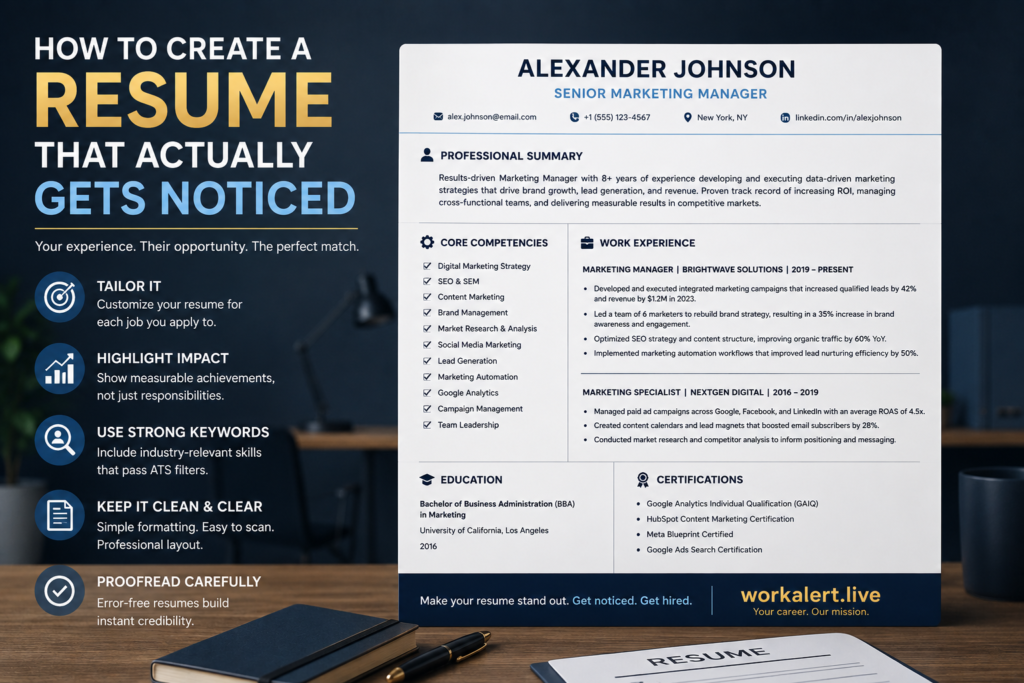
A strong resume opens doors. A weak one closes them before you even get a chance. That’s why knowing how to create a resume properly matters more than most job seekers realise. Whether you’re searching for how to make a CV, how to make a curriculum vitae, or simply how to develop a CV, the core steps are the same. In this guide, we’ll break the process down simply, so you know exactly what to include, what to skip, and how to format everything so it reads clearly to both a human and an ATS system.
If you’d rather skip starting from scratch, a good resume builder can help. Many people now turn to a free resume builder online, a free AI resume builder, or a simple CV maker instead of writing everything by hand. WorkAlert.live offers an easy, guided way to build or make a CV, which is especially handy if you’re short on time or unsure where to begin.
Choosing a Resume Builder or Starting From Scratch:
There’s no single right way to start. Some people prefer to write a resume for free using their own words, while others prefer tools that generate resume online free or even generate resume from LinkedIn using existing profile details. If you want something quick, look at options like:
- A free resume builder and download or free resume creator and download tool
- An online resume maker free PDF option, so you can save your file instantly
- A LinkedIn resume builder, which can make resume from LinkedIn data in minutes
- A Canva resume editor or Canva CV builder, both popular for clean templates
- An easy resume builder app or resume builder app for your phone
Whichever route you choose, from a completely free resume builder to a professional resume writing service, the goal stays the same: present your experience clearly.
Start With the Right Structure of Create a Resume :
Before writing anything, decide on a format. Most resumes follow one of three structures: chronological, functional, or a hybrid of both. The chronological format works best for most people, listing work history from most recent to oldest, since recruiters are used to scanning this layout quickly. However, if you’re switching industries or have gaps in your history, a hybrid format may serve you better by highlighting skills first. Either way, keep the structure consistent — a resume template maker or online resume templates can help you stay organised without much effort.
Write a Strong Summary for Create a Resume :
At the top, add a short summary — two to three sentences is enough. State who you are professionally, what skills you bring, and what role you’re targeting. For example: “Marketing coordinator with 3 years of experience in social media strategy and campaign analytics, seeking a growth-focused digital marketing role.” Keep it specific and avoid vague phrases like “hardworking team player.” Focus on real skills and measurable results instead.
List Your Work Experience Clearly:
Next, move to your work experience. For each role, include your job title, company name, dates worked, and three to five bullet points describing your achievements. Start each bullet with an action verb — “managed,” “created,” “increased,” or “led.” Whenever possible, add numbers, since “Increased email open rates by 22%” is far stronger than “Responsible for email campaigns.” Additionally, only include roles relevant to the job you’re applying for.
Highlight Relevant Skills:
After your experience section, add a skills list. This part matters most for passing ATS filters, since many systems scan for exact keyword matches from the job posting. Therefore, review the job description carefully and match your listed skills to it, as long as they’re truthful. Separate hard skills (software, technical ability) from soft skills (communication, leadership) if space allows.
Include Education and Certifications:
List your highest degree first, followed by the institution name and graduation year. Recent graduates can move this section closer to the top. Certifications or relevant coursework can also strengthen this area, especially if tied directly to the role you want.
Keep Formatting Clean and Simple:
Once the content is ready, focus on formatting. Use a clean font like Calibri, Arial, or Georgia, or try a resume builder Microsoft Word template if you prefer familiar software. Moreover, avoid excessive graphics, tables, or columns, since many ATS systems struggle to read them correctly. Finally, keep your resume to one page if you have less than 10 years of experience; two pages is fine for senior roles.
Proofread Before You Send It:
Before submitting, read through carefully — a resume editor free tool can catch small typos, but a second set of eyes often spots what you’ve read past. Whether you’re using a pro resume builder or writing by hand, this step matters just as much as the content itself.
Don’t Forget the Cover Letter:
Many job seekers ask, “how can I write a CV letter?” A cover letter should complement your resume, not repeat it. A cover letter builder or coverletter maker can speed things up, but keep it short, mention the specific role, and explain briefly why you’re a strong fit.
Final Thoughts:
Learning how to create a resume isn’t about following a rigid template — it’s about presenting your experience clearly and matching it to what employers want. Whether you build my resume using a free tool, hire a resume writing service near me, or write it yourself, clear structure and real achievements will help your resume do its job: getting you the interview.