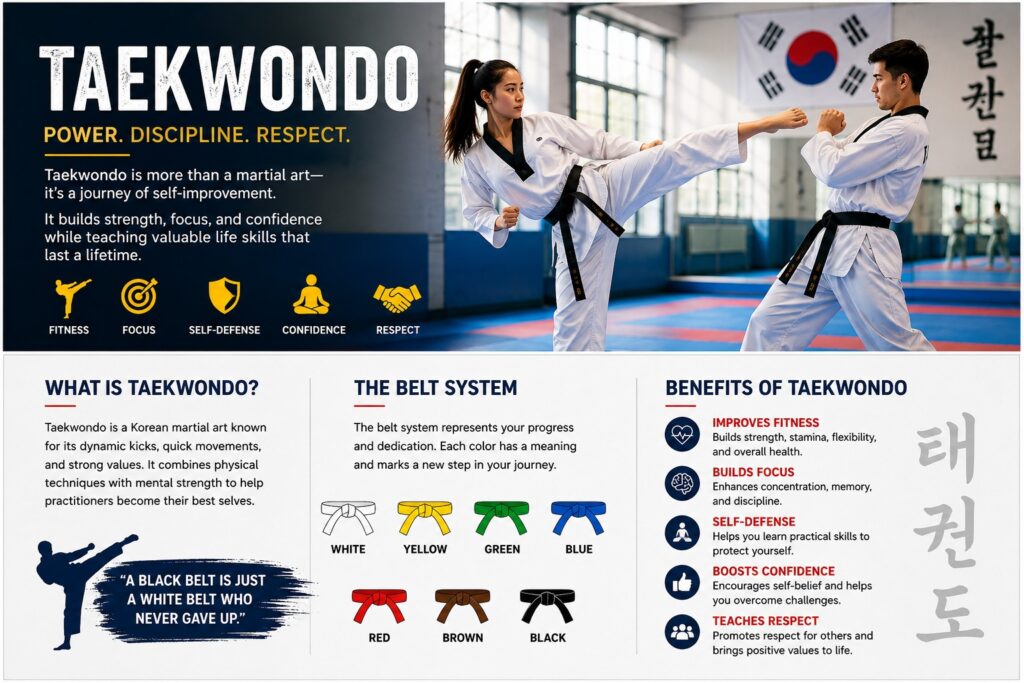
Taekwondo is a Korean martial art that combines movement, technique, discipline, and physical fitness. It is known for its fast kicks, controlled movements, and structured training. Although many people first discover it through sports or self-defense, training can also become a great way to stay active and develop confidence.
For beginners, starting a martial art can seem a little intimidating. There are new movements to learn, unfamiliar terminology, and a ranking system that may look complicated at first. In reality, most training begins with simple fundamentals and gradually becomes more challenging as your skills improve.
What Is Taekwondo?
The art originated in Korea and has developed into one of the world’s best-known martial arts. Its training places strong emphasis on kicking techniques, footwork, balance, flexibility, and timing.
Students also learn how to control their movements and work with training partners in a safe and respectful environment. While physical ability is important, progress is not only about strength or speed. Patience and consistency play a major role.
This makes the discipline suitable for people with different levels of fitness and experience.
What Do Beginners Learn?
A beginner’s first few classes usually focus on the basics rather than advanced techniques.
Students may learn how to stand correctly, move around the training area, maintain balance, and perform basic punches and kicks. Coaches also introduce simple combinations and defensive movements as students become more comfortable.
The goal at this stage is not to perform complicated techniques perfectly. It is to build a strong foundation that can be developed over time.
Regular practice makes movements feel more natural, and students gradually become more comfortable with the pace of training.
Physical Benefits
One of the biggest reasons people join martial arts classes is to become more active.
Training can involve a combination of stretching, footwork, kicking drills, bodyweight exercises, and technique practice. These activities can improve coordination, flexibility, balance, and general fitness.
Because sessions often involve repeated movement, they can also provide a good workout. Over time, students may notice that everyday physical activities feel easier.
However, beginners do not need to be extremely fit before joining. Fitness can improve naturally as training becomes part of their routine.
Building Confidence and Discipline
Martial arts training is not only about physical skills.
Learning a new movement can take time. Sometimes a technique that seems simple can require many attempts before it feels comfortable. Working through those difficulties teaches students to stay patient and keep practicing.
This process can gradually build confidence.
Students also become familiar with following instructions, respecting instructors and training partners, and maintaining focus during practice. These habits can be valuable outside the training environment as well.
The Belt Ranking System
Many schools use a belt system to show a student’s progress.
Beginners normally start at the first level and work toward higher ranks by learning new techniques and demonstrating their understanding. The exact colors, requirements, and testing process can vary between schools.
The ranking system gives students clear goals to work toward. Instead of expecting to master everything immediately, they can focus on the next stage of their development.
Progress is different for everyone, so comparing your journey with another student is rarely helpful.
Training for Children
Children can benefit from martial arts training when classes are properly structured and taught in a safe environment.
Young students can learn basic movement, coordination, listening skills, and respect while staying physically active. Classes are often adapted to the age and ability of the group.
Parents should look for qualified instructors, appropriate supervision, suitable facilities, and a training environment where safety is taken seriously.
The right class should make children feel encouraged rather than pressured.
Training for Adults
Adults can also start martial arts regardless of whether they have previous experience.
Some people join for fitness, while others are interested in learning self-defense or trying something new. Beginners may initially find flexibility or certain movements challenging, but improvement comes with regular practice.
There is no requirement to be exceptionally athletic before starting. A good instructor can help students work at an appropriate level and gradually develop their abilities.
What Happens During a Class?
A typical session can include several different parts.
Training may begin with a warm-up and stretching before moving into basic techniques. Students might then practice individual movements, combinations, footwork, or partner drills.
Depending on the school and class level, there may also be controlled sparring or other practical exercises.
The structure can vary, but the main idea is to learn gradually and practice techniques repeatedly until they become more familiar.
How to Choose a Training School
Choosing the right school is just as important as choosing to start training.
Look for instructors who are experienced, professional, and able to explain techniques clearly. The facility should be clean and suitable for training, and safety should be treated as a priority.
It is also worth asking about class schedules, beginner programs, age groups, fees, and trial sessions if available.
If possible, visit the school before signing up. Watching a class can give you a better idea of the atmosphere and teaching style.
Common Beginner Mistakes
New students sometimes expect progress to happen very quickly. Martial arts require repetition, so trying to master advanced techniques too soon can make learning more difficult.
Another common mistake is focusing only on physical power. Good technique depends on timing, balance, control, and accuracy as well.
Skipping warm-ups or ignoring flexibility work can also make training less comfortable.
The best approach is to listen to your instructor, practice consistently, and allow your skills to develop step by step.
Frequently Asked Questions
Is Taekwondo suitable for complete beginners?
Yes. Beginners normally start with basic movements and gradually progress to more advanced techniques.
Do I need to be physically fit before starting?
No. You can improve your fitness through regular training. It is still important to work within your own ability and progress gradually.
Can children join martial arts classes?
Yes. Many schools offer classes specifically designed for children, with training adapted to their age and ability.
How long does it take to earn a black belt?
There is no single timeline. It depends on the school, training frequency, grading requirements, and the student’s progress.
Is Taekwondo useful for self-defense?
It can teach physical techniques, awareness, movement, and discipline. However, practical self-defense also involves avoiding dangerous situations and making sensible decisions.
Can adults start training later in life?
Yes. Adults can begin at different ages and fitness levels. A suitable beginner program can help new students develop gradually.
Final Thoughts
Taekwondo offers much more than learning a collection of kicks and movements. It combines physical activity with discipline, patience, focus, and continuous improvement.
For beginners, the most important thing is not how quickly they progress but how consistently they practice. With the right instructor and a supportive training environment, students can gradually develop their technique while becoming fitter and more confident.
Whether the goal is fitness, learning a martial art, building discipline, or simply trying something different, starting with the basics is the best way forward.