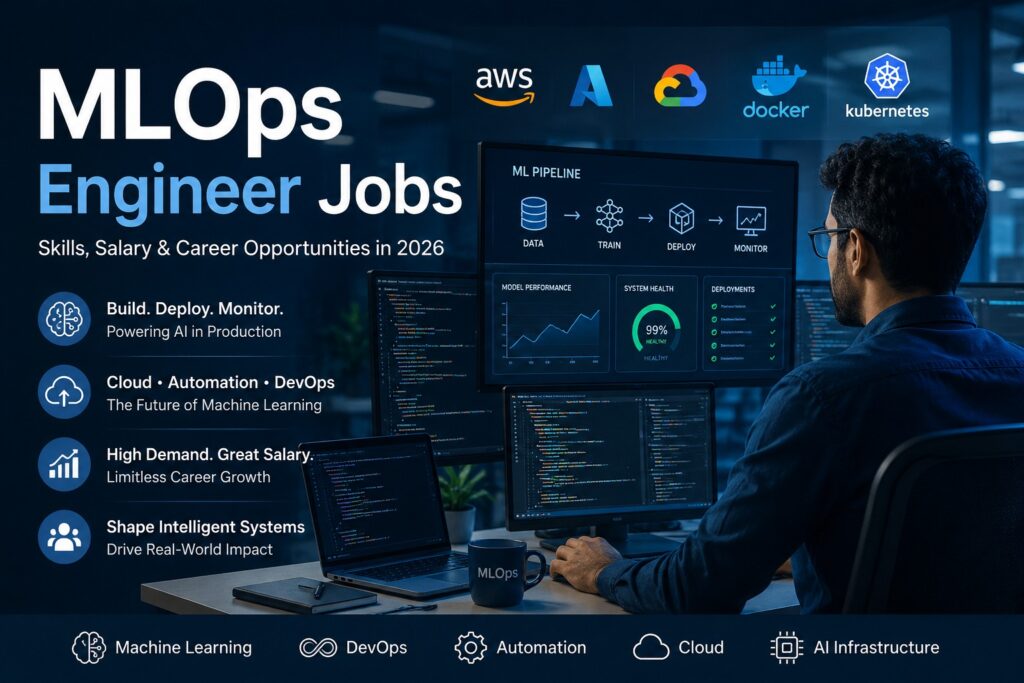
Building a machine learning model is only the beginning. Companies also need reliable systems to deploy, monitor, update, secure, and scale those models in production. That’s where MLOps engineers play an important role.
MLOps combines machine learning, software engineering, DevOps, automation, and cloud infrastructure to help organizations operate machine learning systems more effectively. As businesses continue exploring generative AI and other machine learning applications, professionals with practical MLOps skills can find opportunities across technology, finance, healthcare, retail, and other industries.
For developers, DevOps professionals, cloud engineers, and machine learning specialists, understanding the skills and career paths associated with MLOps engineer jobs can help with planning a career in AI infrastructure in 2026.
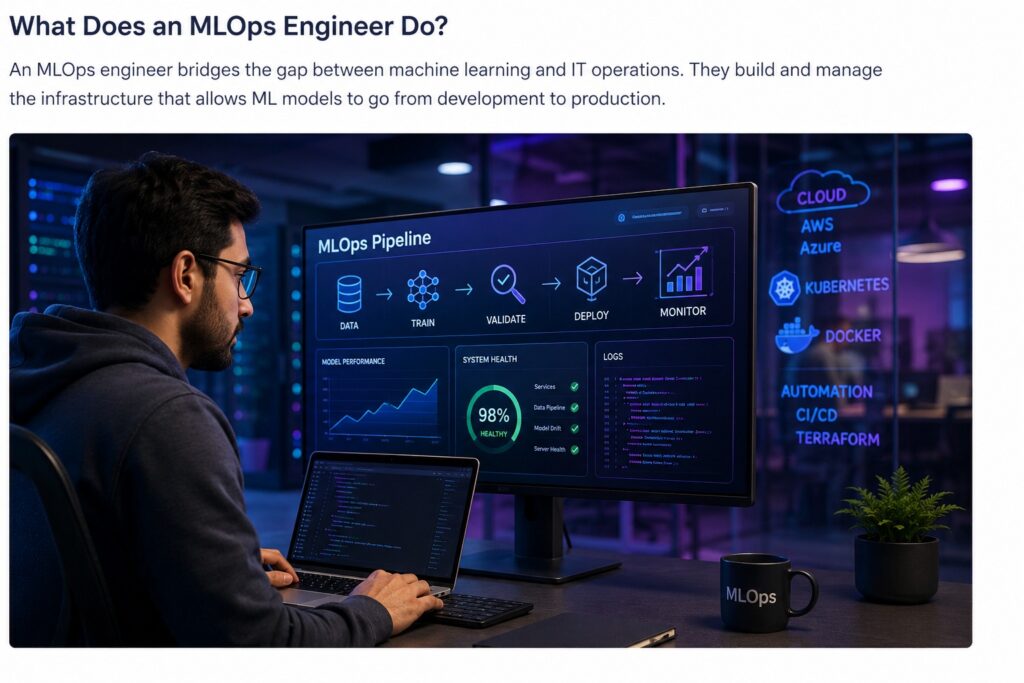
What Does an MLOps Engineer Do?
An MLOps engineer helps connect machine learning development with software engineering and IT operations. Their responsibilities can include deploying models, automating machine learning workflows, monitoring production systems, and maintaining the infrastructure required to run AI applications.
Typical responsibilities may include:
- Building and maintaining ML pipelines
- Automating model training and deployment workflows
- Managing cloud and computing infrastructure
- Monitoring model and system performance
- Supporting model versioning and reproducibility
- Improving application reliability and scalability
- Working with data scientists, ML engineers, software developers, and DevOps teams
- Helping implement security and governance practices
The exact responsibilities vary by employer. Some companies may combine MLOps responsibilities with DevOps, platform engineering, data engineering, or machine learning engineering.
Why Are MLOps Engineer Jobs Growing in 2026?
Organizations are increasingly focused on moving AI and machine learning projects from experimentation into production. A successful production system requires more than a trained model. Companies also need automated pipelines, reliable infrastructure, monitoring, security, version control, and processes for updating models.
Cloud platforms such as AWS, Microsoft Azure, and Google Cloud provide infrastructure and services that organizations can use to build and operate machine learning systems. At the same time, tools for containerization, orchestration, infrastructure as code, and continuous deployment are becoming important parts of modern AI workflows.
Demand for MLOps skills can therefore be found in organizations with significant machine learning workloads, although the number and type of opportunities vary by industry, location, company size, and experience level.
7 Essential Skills for an MLOps Engineer
1. Python
Python is widely used for machine learning, automation, scripting, data processing, and infrastructure workflows. Strong Python fundamentals can provide a useful foundation for MLOps work.
2. Docker and Containers
Docker allows applications and their dependencies to be packaged into portable containers. Understanding containerization can help MLOps engineers create more consistent development and production environments.
3. Kubernetes
Kubernetes is commonly used to orchestrate containerized workloads. Knowledge of Kubernetes can be particularly valuable for engineers working with large-scale cloud and machine learning infrastructure.
4. CI/CD
Continuous integration and continuous delivery or deployment practices help automate testing and software releases. MLOps engineers may extend these principles to machine learning workflows and model deployment.
5. Cloud Computing
Knowledge of at least one major cloud platform—such as AWS, Azure, or Google Cloud—can be useful. Candidates should understand core concepts such as compute, storage, networking, permissions, and deployment.
6. Infrastructure as Code
Tools such as Terraform can help engineers define and manage infrastructure through code. This can improve consistency, automation, and repeatability across environments.
7. Machine Learning Lifecycle and Monitoring
MLOps professionals need to understand how data, models, infrastructure, deployment, and monitoring work together. Knowledge of model versioning, experiment tracking, observability, and model drift can be valuable when maintaining production ML systems.
MLOps vs. DevOps: What’s the Difference?
MLOps and DevOps share many principles, including automation, continuous integration, deployment, monitoring, and infrastructure management. However, MLOps also addresses challenges specific to machine learning.
For example, MLOps workflows may need to manage:
- Training data and data pipelines
- Model versions
- Experiments and model artifacts
- Model deployment
- Model performance
- Data or model drift
- Reproducibility
- ML governance
A DevOps engineer may focus primarily on software applications and infrastructure, while an MLOps engineer must also understand the machine learning lifecycle.
MLOps Engineer Salary and Career Outlook
MLOps engineer salaries can vary considerably depending on location, experience, industry, technical specialization, company size, and responsibilities.
Entry-level professionals may begin by supporting existing cloud environments, deployment pipelines, monitoring systems, or automation workflows. Mid-level engineers may take greater ownership of ML infrastructure and production pipelines.
Senior MLOps engineers can move into areas such as AI platform architecture, technical leadership, ML infrastructure strategy, model governance, and large-scale machine learning systems.
Because compensation varies significantly by market, candidates should compare current salary data for their specific location and experience level rather than relying on a single national figure.
How to Start a Career in MLOps
Dedicated entry-level MLOps positions may be less common than general software development, cloud engineering, DevOps, or data engineering roles. For beginners, these related fields can provide useful experience before specializing in MLOps.
A practical learning path can include:
- Learn Python and Linux fundamentals.
- Understand networking and basic software engineering.
- Learn Git and CI/CD workflows.
- Gain experience with Docker and cloud computing.
- Study databases and data engineering fundamentals.
- Learn basic machine learning concepts.
- Build automated ML pipelines.
- Practice model deployment and monitoring.
- Create practical projects that demonstrate your skills.
A well-organized GitHub portfolio can help demonstrate your ability to build and operate real systems. Projects should show what you built, why you built it, which tools you used, and how the system was deployed or monitored.
Career Paths Related to MLOps
MLOps is connected to several technology career paths. Depending on your background and interests, you may enter the field through roles such as:
- DevOps Engineer
- Cloud Engineer
- Data Engineer
- Machine Learning Engineer
- Platform Engineer
- Software Engineer
With additional experience, professionals can progress toward Senior MLOps Engineer, ML Platform Engineer, Staff Engineer, Principal Engineer, or engineering leadership positions.
Remote MLOps Engineer Jobs
Remote MLOps opportunities are available, but they vary by employer, location, seniority, and business requirements. Some companies operate distributed engineering teams, while others require employees to work from specific locations or follow hybrid schedules.
Security requirements, access to cloud infrastructure, time-zone expectations, and collaboration needs can also affect whether an MLOps position is remote.
When searching for remote MLOps jobs, carefully review the job description for location restrictions and remote-work requirements.
The Future of MLOps Careers
The future of MLOps is closely connected to the expansion of generative AI, enterprise AI, and increasingly automated machine learning workflows.
As organizations deploy more AI systems, they need reliable processes for model deployment, monitoring, version control, infrastructure management, security, and governance. This can create opportunities for engineers who understand both machine learning workflows and production infrastructure.
The field will also continue to evolve as new AI tools and development practices emerge. For job seekers, maintaining strong fundamentals and developing the ability to learn new technologies can be more valuable than focusing on one specific tool.
Frequently Asked Questions
What Does an MLOps Engineer Do?
An MLOps engineer helps deploy, automate, monitor, and maintain machine learning models and the infrastructure that supports them.
Are MLOps Engineers in Demand in 2026?
Organizations deploying machine learning and AI systems at scale may need MLOps skills to support production infrastructure, automation, monitoring, and reliability. However, opportunities vary by employer, industry, location, and experience level.
What Skills Are Required for MLOps Jobs?
Common skills include Python, Linux, Git, Docker, Kubernetes, CI/CD, cloud platforms, infrastructure as code, ML pipelines, monitoring, and an understanding of the machine learning lifecycle.
Can Beginners Get Entry-Level MLOps Jobs?
Yes, but dedicated entry-level MLOps roles may be less common than related software, cloud, DevOps, and data engineering positions. Beginners can build toward MLOps by developing skills in these areas and creating practical machine learning infrastructure projects.
Is MLOps a Good Career for the Future?
MLOps can be a strong career option for people interested in the intersection of artificial intelligence, software engineering, cloud computing, automation, and machine learning infrastructure. Career prospects depend on individual skills and market conditions.
What Tools Should an MLOps Engineer Learn?
Useful tools and technologies can include Python, Git, Docker, Kubernetes, Terraform, CI/CD platforms, cloud services, ML pipeline tools, monitoring systems, and databases. The specific technology stack varies by employer.
Find More Job Opportunities With WorkAlert
If you’re actively looking for your next career opportunity, WorkAlert can help you discover job openings across different industries and locations. You can explore opportunities ranging from remote and freelance positions to part-time and full-time roles, making it easier to compare jobs that match your skills, experience, and career goals. Checking relevant job listings regularly can help you stay informed and act quickly when a suitable opportunity becomes available.
Conclusion
MLOps engineer jobs sit at the intersection of machine learning, software engineering, DevOps, and cloud infrastructure. As organizations work to deploy AI systems reliably in production, professionals who understand automation, infrastructure, monitoring, and the machine learning lifecycle can build valuable technical expertise.
For beginners, entering MLOps may involve first gaining experience in software development, cloud engineering, DevOps, data engineering, or machine learning. Building practical projects, learning widely used technologies, and developing strong engineering fundamentals can help candidates prepare for this evolving career path in 2026.