
In a job market full of layoffs and shrinking benefits, Louisiana civil service jobs stand out as one of the most stable career paths available to US workers today. Between a defined-benefit pension through LASERS, comprehensive state health coverage, structured paid leave, and predictable pay progression, it’s no surprise that Louisiana government jobs and Louisiana classified jobs consistently attract heavy applicant interest from candidates pursuing genuine Louisiana state government careers.
So what exactly does “Louisiana Civil Service” mean for applicants? In short, it’s the merit-based hiring and employment system that governs most jobs within Louisiana state government — a system designed to hire based on qualifications and testing rather than political connections, and to protect employees from arbitrary termination once permanently appointed. This guide walks through everything you need to know to successfully pursue Louisiana civil service jobs in 2026, from understanding job types to acing the application and testing process.
Looking for the latest job openings and career updates? Visit workalert.live for regularly updated listings and career resources
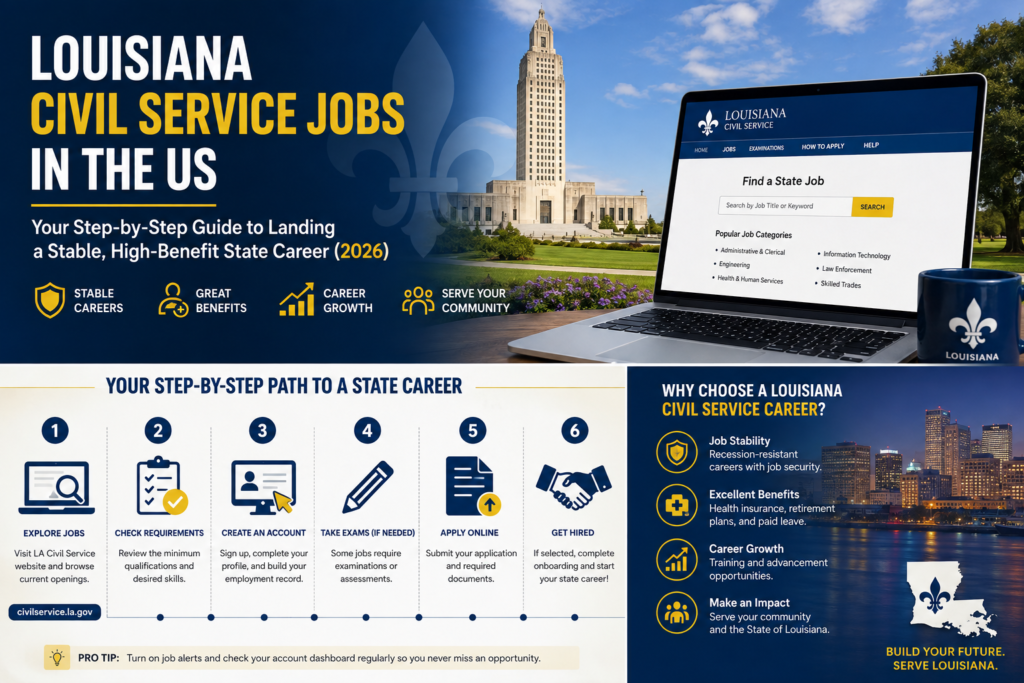
Why Pursue a Career with the State of Louisiana?
Before diving into the application process, it’s worth understanding exactly what makes Louisiana state employment worth pursuing in the first place.
- LASERS Retirement Benefits: The Louisiana State Employees’ Retirement System provides eligible classified employees with a defined-benefit pension — a genuine rarity in today’s private sector, where 401(k)-style plans dominate.
- Comprehensive Health Coverage: Most classified state positions come with access to health, dental, and vision plans through the Office of Group Benefits, often at group rates far below what individuals pay on the private market.
- Structured Paid Leave: Employees accrue annual and sick leave from day one, with accrual rates that increase alongside years of service.
- Career Progression Groups: Louisiana civil service careers are built around defined job series and pay schedules, meaning your path from entry-level to senior roles is transparent rather than arbitrary.
Taken together, these benefits make Louisiana government employment a genuinely competitive alternative to private-sector work, especially for candidates prioritizing long-term security over short-term salary spikes.
Types of Louisiana Civil Service Positions Available
Not every Louisiana state job works the same way. Understanding the distinction between classified and unclassified roles is essential before you start applying.
Classified vs. Unclassified: A Quick Comparison
| Classified (Civil Service) Positions | Unclassified Positions |
|---|---|
| Covered by State Civil Service rules and protections | Exempt from most civil service hiring rules |
| Typically require passing an exam or meeting Minimum Qualification Requirements (MQRs) | Often hired at agency discretion without standardized testing |
| Employees gain job protection after a probationary period | Employment is generally at-will, similar to private-sector jobs |
| Covers most Louisiana job vacancies in administration, healthcare, and law enforcement | Common in higher education, elected offices, and agency leadership roles |
| Hiring is conducted through LA Careers with standardized scoring | Hiring may involve more direct agency discretion |
High-Demand Sectors for Louisiana State Jobs
Several agencies consistently post high volumes of Louisiana state job openings:
- Department of Transportation and Development (DOTD): Engineering technicians, project managers, and maintenance roles supporting the state’s infrastructure.
- Department of Children and Family Services (DCFS): Case managers, eligibility examiners, and social services roles supporting Louisiana families.
- Louisiana Department of Health (LDH): Nursing, behavioral health, and public health positions across state hospitals and community health offices.
- Law Enforcement and Protective Services: Corrections officers, probation and parole agents, and campus or facility security roles requiring specialized testing.
How to Apply for Louisiana Civil Service Jobs (Step-by-Step)
Step 1: Navigate the LA Careers / NEOGOV Portal
All Louisiana civil service job applications are submitted through LA Careers at jobs.la.gov, the state’s official job board built on the NEOGOV applicant tracking platform. Create a single applicant profile — the system flags duplicate accounts — and complete every section thoroughly, since resumes alone are not accepted in place of the online application.
Step 2: Understand Job Specifications and Minimum Qualification Requirements (MQRs)
Every posting links to an official job specification outlining the Minimum Qualification Requirements (MQRs) — the education, experience, or licensure thresholds you must meet to be considered. Read these carefully before applying; failing to clearly demonstrate you meet MQRs in your application is one of the most common reasons qualified candidates get screened out early.
Step 3: Prepare for State Civil Service Testing
Depending on the job series, you may need to pass one of several standardized exams:
- Law enforcement and protective services testing for corrections, security, and related roles.
- Professional-level testing covering entry-level professional job series.
- Administrative and clerical testing for office support positions.
Testing is free, offered on a continuous basis at locations across the state, and typically requires a picture ID and Social Security documentation on test day. A little Louisiana civil service test prep goes a long way — review sample question booklets where available, and time yourself under realistic conditions. Scores are generally transmitted automatically to hiring agencies once you apply — so testing before a specific vacancy opens is a smart strategy for competitive job series.
Step 4: Submit a Competitive Application and Track Your Status
Once your Louisiana job applications and any required test scores are on file, monitor new Louisiana job vacancies regularly and apply promptly, since many postings stay open for as little as five calendar days. Track your application status directly through your LA Careers applicant portal account rather than waiting on email alone.
Decoding Louisiana Civil Service Pay Schedules
Louisiana civil service pay is organized around structured pay schedules — commonly referenced by letter codes such as AS (Administrative Support), TS (Technical Services), PS (Professional Services), and MS (Managerial Services) — each covering a range of job series with similar responsibility levels. Within each schedule, positions are assigned a specific pay grade with a defined hiring rate and a maximum rate.
Once hired, employees generally advance through step increases tied to satisfactory performance and time in service, rather than through unpredictable raises. This structure means two people doing the same job at the same agency are paid on a transparent, standardized scale — a meaningful difference from many private-sector pay structures where compensation can vary widely for similar work. Because exact Louisiana state pay schedules and rates are periodically updated, always confirm current figures directly on the official job posting or the State Civil Service pay schedule pages before accepting an offer.
Expert Tips to Stand Out in the Hiring Process
Standing out in a competitive applicant pool takes more than just submitting an application. Keep these strategies in mind:
- Mirror the job description’s language. Use the same terminology found in the official civil service job description when describing your work history — automated and human reviewers alike are scanning for direct matches to required competencies.
- Quantify your experience. Wherever possible, use numbers (years of experience, team size managed, caseloads handled) rather than vague descriptions.
- Test early for competitive series. If you’re targeting law enforcement, technical, or professional roles requiring an exam, take the test before applying so your score is already active.
- Apply broadly across agencies. The same job title can be open at multiple Louisiana state agencies simultaneously — applying to several increases your overall odds.
- Don’t skip supplemental questions. Situational and competency-based supplemental questions are often scored separately from your base application, so treat every response with the same care as a cover letter.
Conclusion: Start Your Louisiana Civil Service Career Today
Louisiana civil service jobs offer a rare combination in today’s economy: real job security, a defined-benefit retirement plan, strong health coverage, and a transparent path for career growth. Whether you’re relocating from out of state or already based in Louisiana, these state of Louisiana jobs across DOTD, DCFS, LDH, and law enforcement agencies are consistently open to qualified applicants willing to navigate the process carefully. From classified administrative roles to specialized Louisiana public sector jobs in healthcare and law enforcement, Louisiana employment opportunities span nearly every skill set and career stage.
Don’t wait for the “perfect” opening — create your LA Careers profile today, review current job specifications, and start preparing for any required testing now. If this guide helped clarify the Louisiana state job application process, share it with someone in your network who’s searching for stable public-sector employment, and drop a comment below with any questions about your own state government job search.
Frequently Asked Questions
Do all Louisiana state jobs require a test?
No. Testing requirements depend entirely on the specific job series. Many law enforcement, technical, and professional-level positions require passing a standardized civil service exam, while other classified and unclassified roles are filled based on the online application, minimum qualifications, and supplemental questions alone.
How long does the state hiring process take?
Timelines vary by agency and position, but most Louisiana job vacancies remain posted for a minimum of five calendar days, with some frequently filled roles accepting applications continuously. After the posting closes, review, testing (if required), and interview stages can take anywhere from a few weeks to a couple of months depending on the agency’s hiring volume and process.