Every contact center and operations team relies on data, but data is only useful when someone can monitor it and act on it quickly. That is where real time analyst jobs come in.
Real time analysts monitor live operational performance, identify staffing or service-level issues, and help operations teams respond before small problems become major ones. For people interested in workforce management and operations analytics, the role can also be a strong starting point for career growth.
For job seekers looking for reliable and regularly updated opportunities, WorkAlert.live is a useful platform for discovering job openings across different industries and locations. The site provides manually checked job listings, direct application links, and practical career resources to help candidates search more efficiently. Whether you’re looking for remote positions, entry-level roles, or experienced professional opportunities, WorkAlert.live can help you explore relevant vacancies and take the next step in your career.
What Does a Real Time Analyst Do?
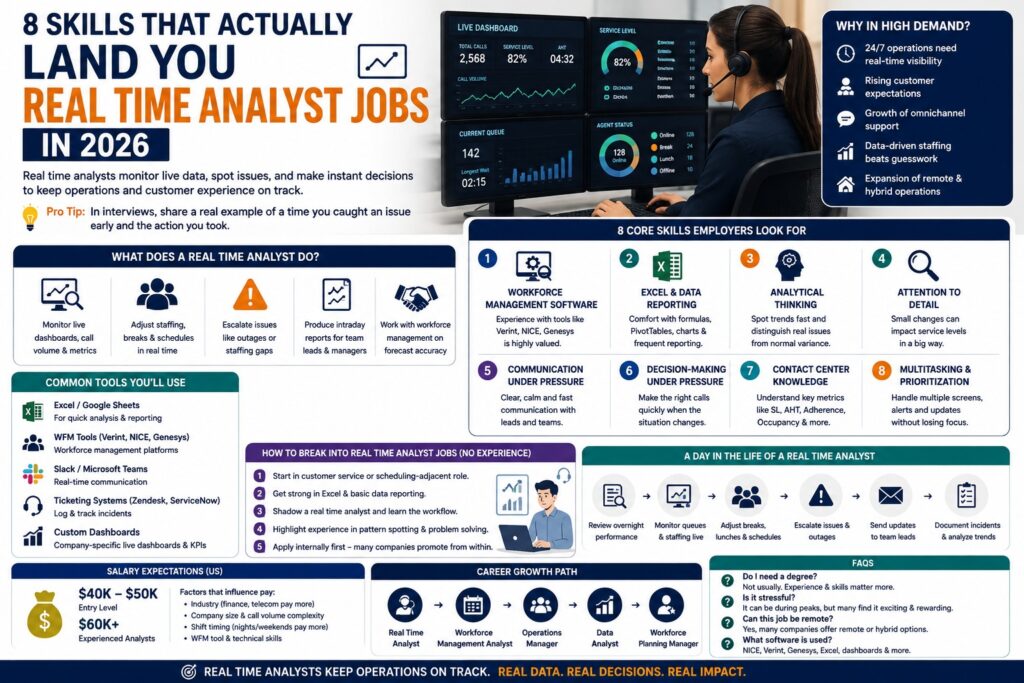
A real time analyst monitors live operational data such as call volumes, staffing levels, queue activity, and service levels. Their job is to identify changes quickly and coordinate appropriate actions to keep operations running efficiently.
Typical responsibilities include:
- Monitoring live call volume, staffing, and service-level dashboards
- Tracking agent adherence and availability
- Coordinating schedule changes, breaks, and lunches when necessary
- Escalating staffing shortages, system issues, or unusual activity
- Preparing intraday reports for team leaders and operations managers
- Working with workforce managementteams to address operational gaps
Why Are Real Time Analyst Jobs in Demand?
Organizations that operate contact centers and other time-sensitive support operations need accurate, real-time visibility into their workforce.
Several trends have increased the importance of real time analysis:
- Growth of remote and hybrid contact center operations
- Higher customer expectations for quick responses
- Expansion of omnichannel support across voice, chat, and email
- Greater reliance on data-driven workforce decisions
- Increasing complexity in staffing and scheduling
A real time analyst helps managers understand what is happening right now so they can make informed operational decisions.
8 Skills Employers Look for in Real Time Analysts
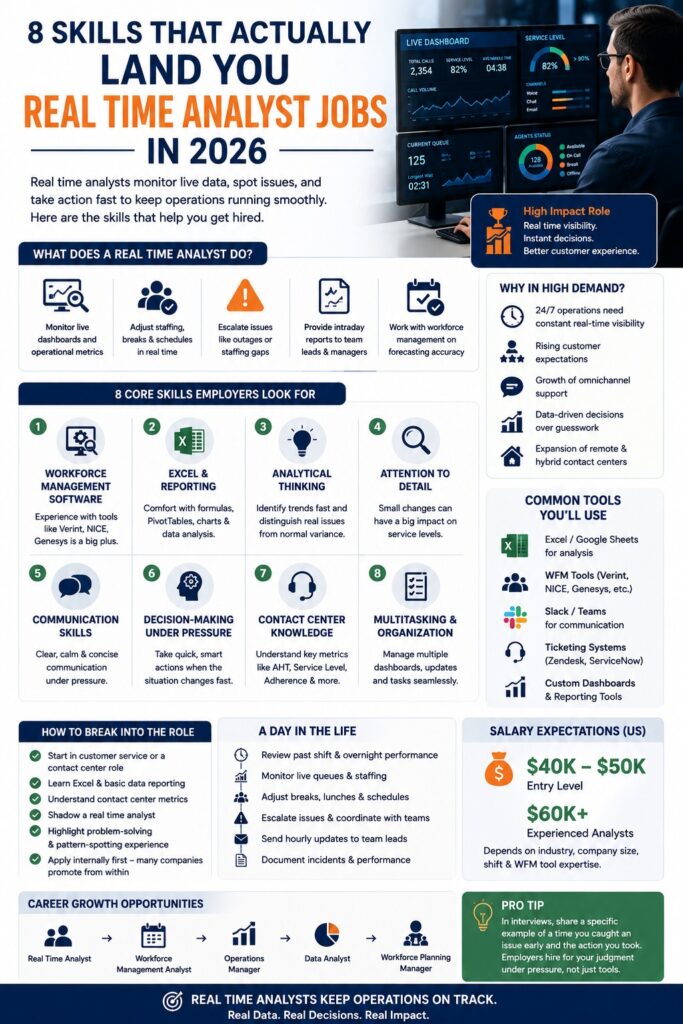
Employers typically look for a combination of technical knowledge, analytical ability, communication skills, and the ability to remain calm under pressure.
1. Workforce Management Software
Familiarity with workforce management software can be highly valuable. Common platforms include NICE, Verint, Genesys, and other systems used for forecasting, scheduling, adherence, and intraday management.
You do not necessarily need experience with every platform. Understanding the basic principles behind workforce management can make it easier to learn new systems.
2. Excel and Data Reporting
Excel remains an important tool for many real time analysts. You should be comfortable working with spreadsheets, formulas, filters, sorting, and basic reporting.
Useful Excel skills include:
- SUM and COUNT functions
- IF statements
- VLOOKUP or XLOOKUP
- Pivot tables
- Basic charts
- Data filtering and formatting
Strong spreadsheet skills can help you analyze operational information quickly.
3. Analytical Thinking
Real time analysts need to recognize whether a change in performance is a temporary fluctuation or a genuine operational problem.
For example, if call volume suddenly increases while staffing levels remain unchanged, you need to assess the potential impact on service levels and determine whether action is required.
Good analytical thinking helps you move from “What is happening?” to “Why is it happening, and what should we do next?”
4. Attention to Detail
Small changes in staffing, adherence, or queue performance can have a significant impact on operations.
Real time analysts need to monitor multiple data points without overlooking important details. Strong attention to detail is particularly important when making schedule adjustments or escalating operational issues.
5. Communication Skills
Real time analysts regularly communicate with team leaders, supervisors, workforce management teams, and operations managers.
When an issue occurs, communication needs to be:
- Clear
- Concise
- Accurate
- Timely
- Professional
Being able to explain a problem quickly and recommend an appropriate action is an important part of the role.
6. Decision-Making Under Pressure
Real time analysis often involves making decisions when conditions are changing quickly.
You may need to respond to a sudden increase in call volume, unexpected absenteeism, a system outage, or a service-level decline.
Pro tip: During interviews, explain your decision-making process rather than only giving the final answer. Show how you identify the problem, evaluate the available information, consider the impact, and choose an appropriate action.
7. Knowledge of Contact Center Operations
Understanding how a contact center works can give you a significant advantage.
Learn the basics of concepts such as:
- Service level
- Average handle time (AHT)
- Occupancy
- Adherence
- Abandonment rate
- Shrinkage
- Forecasting
- Staffing requirements
The better you understand these metrics, the easier it becomes to identify operational problems.
8. Ability to Multitask
Real time analysts may monitor dashboards, communicate with supervisors, update schedules, review reports, and respond to operational issues at the same time.
Being organized and able to prioritize tasks is therefore essential. You need to maintain awareness of the overall operation while handling individual issues as they arise.
How to Get Real Time Analyst Jobs With No Experience
You do not always need previous experience as a real time analyst to enter the field. Customer service, call center, scheduling, workforce management, and operations experience can provide useful transferable skills.
Here are some practical steps:
- Gain experience in a customer service or contact center environment.
- Learn Excel and basic data reporting.
- Understand common contact center performance metrics.
- Learn the fundamentals of workforce management.
- Ask to shadow a real time analyst or workforce management team.
- Highlight experience involving monitoring, problem-solving, scheduling, or reporting.
- Apply for internal opportunities where possible.
Internal candidates can sometimes have an advantage because they already understand the company’s systems, processes, and operational environment.
A Day in the Life of a Real Time Analyst
Every shift can be different, but real time analysts typically follow a continuous cycle of monitoring, identifying, communicating, and responding.
A typical shift may include:
- Reviewing previous-shift performance
- Monitoring live queues and staffing levels
- Tracking agent adherence and availability
- Coordinating breaks and lunches around operational demand
- Identifying unexpected changes in call or contact volume
- Escalating system or staffing issues
- Sending intraday performance updates
- Documenting incidents and actions for later analysis
The role requires constant attention because conditions can change throughout the day.
Common Tools Used by Real Time Analysts
In addition to workforce management platforms, analysts often use several other tools to monitor performance and communicate with operations teams.
Common examples include:
- Excel or Google Sheetsfor calculations and reporting
- NICE, Verint, or Genesysfor workforce management
- Microsoft Teams or Slackfor communication and escalation
- Zendesk or ServiceNowfor tracking certain operational issues
- Internal dashboardsfor monitoring company-specific KPIs
Pro tip: If a job description mentions a workforce management platform you have never used, do not automatically rule yourself out. Focus on your transferable knowledge of forecasting, scheduling, adherence, staffing, and intraday management.
Real Time Analyst Salary Expectations
Salary varies considerably depending on location, industry, experience, company size, and shift requirements.
In the United States, entry-level real time analyst positions may start around the lower end of the contact-center analytics market, while experienced professionals can earn considerably more, particularly in industries such as finance, technology, and telecommunications.
Factors that can influence compensation include:
- Industry and company size
- Years of experience
- Workforce management software expertise
- Technical and analytical skills
- Shift patterns and working hours
- Location
- Contract versus permanent employment
Always check current salary information for your specific location and experience level because compensation can change significantly between employers.
Career Growth Beyond the Real Time Analyst Role
A real time analyst position can provide valuable experience in workforce management, operations, and analytics.
With experience, professionals may move into roles such as:
- Workforce Management Analyst— focusing on forecasting, scheduling, and capacity planning
- Workforce Planning Manager— managing longer-term staffing strategies
- Operations Manager— overseeing broader operational performance
- Data Analyst— focusing more heavily on reporting and data analysis
- Workforce Management Manager— leading workforce management teams and processes
Developing stronger Excel, reporting, analytical, and workforce management skills can help you move toward these positions.
How to Prepare for a Real Time Analyst Interview
Real time analyst interviews often include practical or scenario-based questions designed to test your judgment.
For example, an interviewer might ask:
“Call volume suddenly increases while service levels are falling. What would you do?”
A strong answer should demonstrate a logical process:
- Check the available data and confirm the issue.
- Identify the likely cause.
- Review staffing and agent availability.
- Assess current and expected operational impact.
- Communicate the issue to the appropriate team.
- Recommend or implement an appropriate action.
- Continue monitoring the situation.
Before your interview, prepare examples that demonstrate problem-solving, communication, attention to detail, and the ability to work under pressure.
Frequently Asked Questions
Do Real Time Analyst Jobs Require a Degree?
Not always. Many employers focus on relevant operational experience, analytical skills, Excel knowledge, and familiarity with workforce management. A degree may be preferred for some positions or useful for future career progression.
What Software Do Real Time Analysts Typically Use?
Common workforce management platforms include NICE, Verint, and Genesys. Analysts may also use Excel, communication platforms, ticketing systems, and internal performance dashboards.
Is Being a Real Time Analyst Stressful?
The role can be demanding, particularly during peak periods, staffing shortages, or system outages. However, people who enjoy fast-paced environments, problem-solving, and data-driven decision-making may find the work rewarding.
Can Real Time Analyst Jobs Be Remote?
Some companies offer remote or hybrid real time analyst positions, while others require analysts to work on-site. The arrangement depends on the employer, operational requirements, and security policies.
Final Thoughts
Real time analyst jobs can be an excellent entry point into workforce management, operations, and analytics. Success in the role requires more than simply watching a dashboard—you need analytical thinking, strong communication, attention to detail, workforce management knowledge, and the ability to make decisions quickly.