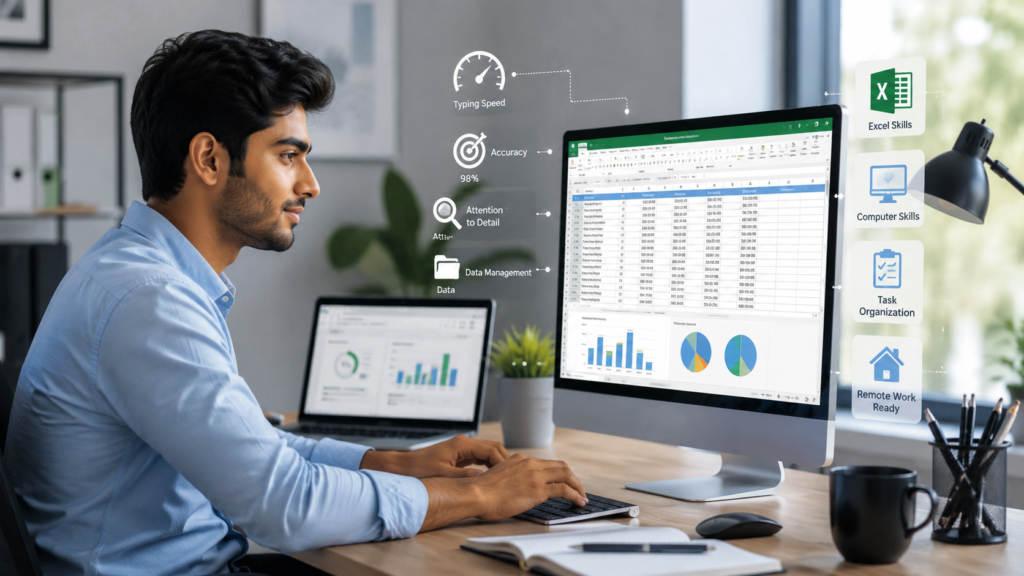
Data entry has evolved fast. It’s no longer just fast typing — in 2026, you’re working alongside AI validation tools, CRM systems, and automated workflows that catch errors before you even hit submit. Yet the appeal hasn’t faded: flexible hours, low barrier to entry, and genuine remote opportunity. Whether you’re a student, a career-switcher, or a freelancer hunting for stable income, understanding the current data entry job requirements 2026 employers actually expect is the fastest way to get hired. This guide breaks down eligibility, skills, daily duties, and a real hiring roadmap.
Basic Eligibility Criteria (2026 Standards)
Before diving into skills and tools, it’s worth understanding the baseline data entry job requirements employers check first — education, age, and identity verification.
Educational Background
- Minimum: A High School Diploma, GED, or Intermediate certificate satisfies most entry-level data entry education requirements.
- Competitive edge: A Bachelor’s degree, IT diploma, or business administration background helps for specialist or medical/legal roles.
Age & Identity Verification Most employers require applicants to be 18 years or older, with valid government ID (CNIC/passport) and proof of work eligibility for remote or contract roles — standard data entry clerk requirements across global platforms.
Experience Levels
- Freshers: Many listings target data entry jobs no experience needed, relying instead on a typing test and short assessment.
- Experienced specialists: Roles in healthcare, legal, or finance often require 1–3 years of relevant background plus sector knowledge.
Core Technical Skills
| Skill Area | Entry-Level Standard | Advanced/Competitive Standard |
|---|---|---|
| Typing Speed | 40–50 WPM | 70+ WPM |
| Accuracy | 95%+ | 98%+ |
| Software | MS Excel, Google Sheets | Access, SQL basics, Airtable, Notion |
| Modern Tools | Basic OCR use | AI validation tools, Zapier, Power Automate |
These benchmarks form the practical core of data entry qualifications most job boards list today. Typing speed and accuracy remain non-negotiable — a fast typist with poor accuracy won’t pass probation.
Modern 2026 tools worth learning:
- AI-powered data-validation software that flags anomalies automatically
- OCR scanners for digitizing paper records
- Workflow automation (Zapier, Power Automate) to reduce repetitive entry
Critical Soft Skills
- Attention to detail — spotting duplicates, mismatched fields, and formatting errors
- Time management — essential for remote/freelance schedules with no direct supervision
- Confidentiality awareness — basic understanding of GDPR/HIPAA when handling sensitive records
- Communication — reporting progress clearly to teams or clients
Daily Job Duties & Specializations
Typical day-to-day work includes transcription, data cleaning, CRM record updates, and ERP system inputs. Beyond generalist roles, several niches are growing:
- Medical Data Entry — patient records, billing codes, HIPAA compliance
- Legal Transcription — case files, court documents
- E-commerce Product Listing — catalog uploads, SEO-friendly descriptions
- Data Cleaning/Verification — auditing databases for accuracy, a fast-growing category tied to data verification jobs
How to Get Hired Fast in 2026
- Build an ATS-friendly resume — use standard headings, include measurable typing speed/accuracy, and mirror keywords from the job post.
- Get certified — Microsoft Office Specialist and Google Data Analytics certificates are low-cost signals of credibility.
- Apply where the jobs are — Upwork and Fiverr for freelance, LinkedIn and Indeed for structured roles, and direct corporate career portals for stable, long-term positions.
- Test your typing speed before applying — most employers screen with a timed test upfront.
If you want a head start, WorkAlert.live curates fresh remote and on-site data entry openings daily, so you don’t have to dig through outdated listings on generic job boards. It’s built specifically for job seekers who want verified, up-to-date postings without the noise — a solid first stop alongside Upwork, LinkedIn, and Indeed when hunting for your next data entry role.
Meeting the core data entry job requirements — verified ID, baseline typing metrics, and software familiarity — gets your application past the first filter. Everything beyond that (certifications, niche experience, tool fluency) is what separates offers from rejections.
Frequently Asked Questions
Still unsure about specific data entry job requirements? Here are quick answers to the questions job seekers ask most.
Can I do data entry with no experience? Yes. Many entry-level listings explicitly state data entry no experience needed — a solid typing test score and basic software knowledge are usually enough to start.
Is a college degree mandatory for data entry jobs? No. A high school diploma or equivalent meets minimum data entry requirements for most roles; a degree only helps for specialized or senior positions.
Can I perform data entry jobs using a mobile phone or tablet? Basic tasks (form entry, simple data verification) are possible on tablets, but most roles still require a computer for spreadsheet and database software.
How much do data entry specialists earn on average in 2026? Entry-level remote roles typically pay $15–$22/hour, while specialized medical, legal, or bilingual data entry work can reach $25–$35/hour depending on region and experience.
Ready to Start?
Test your typing speed today, polish your resume with the skills above, and start applying with confidence. Subscribe for more career guides as remote job standards keep evolving in 2026.