
The role of the Creative Director has changed more in the last three years than in the previous two decades combined. Between AI-assisted design tools, data-driven brand strategy, and an ever-shrinking gap between creative vision and business outcomes, creative director jobs now demand a fundamentally different skill set than they did a decade ago. Whether you’re a senior designer eyeing your next promotion or a hiring manager benchmarking today’s market, this guide breaks down exactly what modern creative director careers require — and how to land or fill one successfully.
The Modern Landscape of Creative Direction Hiring
Demand for creative director job openings has shifted noticeably across three sectors in particular.
Tech companies are hiring creative leadership to unify product design, marketing, and brand voice under a single strategic vision, rather than treating creative as a downstream function. As product and marketing teams increasingly overlap, creative directors are being pulled into product roadmap conversations far earlier than they used to be.
E-commerce brands need creative director positions that can move fast — producing high volumes of testable creative while still protecting brand consistency at scale. This has pushed many e-commerce companies toward hybrid creative leadership models, blending traditional brand oversight with rapid, data-informed creative testing.
Agencies continue to hire heavily for advertising creative director jobs and digital creative director jobs, but increasingly expect candidates to demonstrate fluency in AI-assisted production workflows alongside traditional campaign strategy. Clients are asking agencies to produce more creative variations faster, and that pressure flows directly into what agencies expect from their creative leads.
This shift means creative director career opportunities are no longer confined to traditional advertising agencies. Brand creative director jobs and marketing creative director jobs inside in-house teams now frequently out-compete agency roles on both pay and stability, reversing a dynamic that held for most of the last twenty years. For candidates evaluating where to build a long-term career, understanding these sector-level differences matters just as much as understanding the creative director job description itself.
Key Responsibilities & Skills Required
Top US companies hiring for this role are consistently looking for a blend of creative and business competencies, and a modern creative director job description typically covers four core pillars:
- Team leadership: Managing designers, art directors, copywriters, and often cross-functional partners in product or marketing. This includes hiring, mentoring, and setting creative standards across a growing team.
- Vision execution: Translating brand strategy into consistent creative output across every channel and touchpoint, from paid social to product packaging to in-app experience.
- AI tool integration: Fluency with generative design and content tools isn’t optional anymore — companies expect creative leaders to know where AI accelerates production and where human judgment still has to lead. Directors who can build efficient AI-assisted workflows without sacrificing brand quality are increasingly prioritized over those relying purely on traditional production methods.
- ROI-driven creative strategy: The ability to tie creative decisions to measurable business outcomes — conversion rates, brand lift, engagement — rather than relying on subjective taste alone.
This combination is exactly why senior creative leadership roles increasingly sit closer to the executive table than they did in previous generations, with many creative directors now reporting directly to a CMO or CEO rather than a VP of Marketing several layers removed from leadership.
Creative Director Salary Expectations & Market Rates (US)
Creative director salary US figures vary significantly by location, industry, and company stage, but here’s a general market overview:
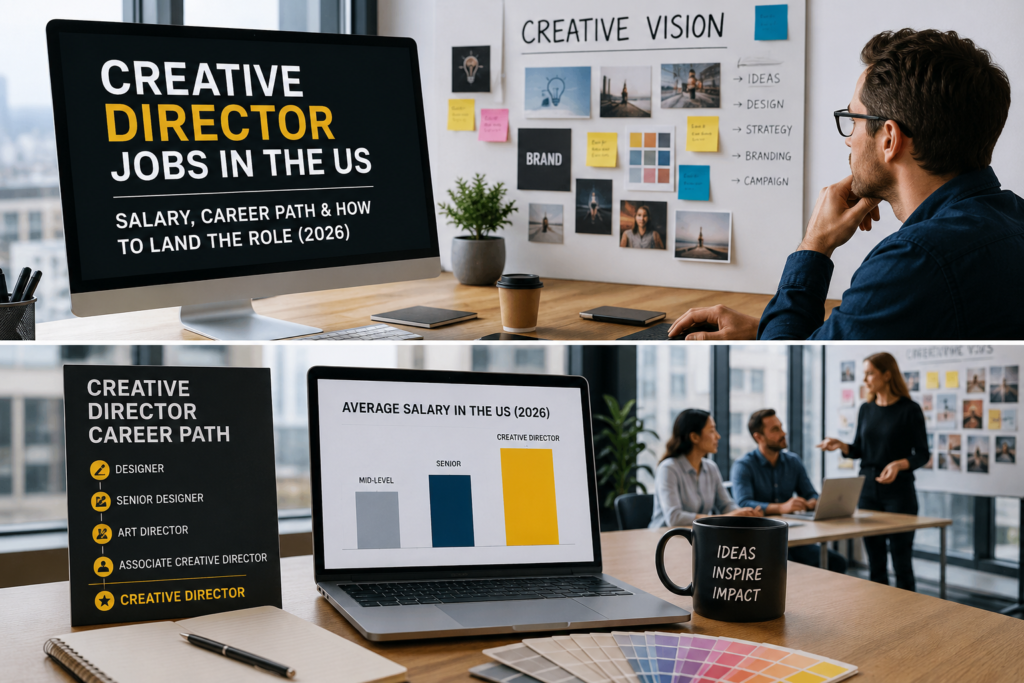
- Base salary: Most creative director positions in mid-size companies and agencies fall between $130,000 and $180,000 annually.
- High-cost markets (NYC, SF, LA): Base pay frequently exceeds $180,000–$220,000+, particularly at well-funded tech and e-commerce companies competing hard for senior creative talent.
- Remote creative director positions: Often benchmarked slightly below top-market rates but still commonly land in the $120,000–$170,000 range, especially for candidates with strong portfolios and proven remote leadership experience.
- Bonuses and equity: Performance bonuses of 10–20% of base are common at agencies and tech companies alike, with equity packages increasingly standard at venture-backed startups.
Always cross-check current figures against live postings and salary aggregators before negotiating, since compensation for design director jobs and creative leadership jobs shifts meaningfully year to year based on hiring demand and overall market conditions. Location remains one of the biggest single variables: a director title at a Series C startup in Austin may pay meaningfully less in base salary than an equivalent role in Manhattan, even when responsibilities are nearly identical — though the gap often narrows once cost of living and equity upside are factored in.
Agency vs. In-House Creative Director: Which Path Fits You?
The agency vs. in-house creative director decision is one of the most consequential choices in a creative leader’s career, and it shapes daily workload, growth trajectory, and long-term specialization far more than most candidates expect going in.
| Role Type | Key Characteristics |
|---|---|
| In-House | Deep focus on a single brand; steadier workload; closer ties to business strategy and product |
| Agency | Exposure to multiple clients and industries; higher pace; strong for building a diverse portfolio fast |
| Remote | Greater flexibility and often broader candidate pool competition; requires exceptional async communication and self-direction |
In-house brand creative director jobs tend to offer more predictable hours and deeper strategic involvement, since you’re building long-term familiarity with one brand’s audience, voice, and business goals rather than switching context between clients. Creative agency jobs, by contrast, typically move faster and expose you to a wider range of industries and creative problems — valuable for building a diverse portfolio, but often more demanding in terms of pace and client management.
Remote creative director positions have grown substantially since 2021, but competition for the best of these roles has grown just as fast, since geography no longer limits the applicant pool the way it once did. Candidates pursuing remote roles should expect a genuinely national (or global) pool of competition, which raises the bar on portfolio quality and interview preparation considerably.
How to Become a Creative Director: Landing High-Paying Roles
Understanding how to become a creative director — or moving from one director-level role to a better one — comes down to a few consistently effective strategies:
- Curate a business-outcome-focused portfolio. Don’t just show beautiful work; show the business problem it solved and the measurable result it drove. Hiring managers increasingly skim past pure aesthetics in search of strategic thinking.
- Build executive-level networking habits. Many creative director career opportunities are filled through referrals and industry relationships long before they’re publicly posted on job boards.
- Invest in personal branding. A strong LinkedIn presence, published thought leadership, or speaking engagements signal executive readiness far more effectively than a resume alone.
- Demonstrate AI fluency explicitly. Call out specific tools and workflows you’ve integrated into your creative process — this has quickly become a differentiator between otherwise similar candidates.
- Target the right entry point. True entry-level creative director jobs are rare; art director jobs, design director jobs, or associate creative director roles are the more realistic stepping stones toward the top title, and skipping this step is one of the most common mistakes ambitious candidates make.
- Prepare a leadership narrative, not just a design narrative. Interviewers at this level are evaluating your ability to manage people and stakeholders as much as your creative eye, so be ready to discuss specific team leadership and conflict-resolution examples.
Conclusion: Your Next Move in Creative Leadership
Creative director careers in the US have evolved into genuinely strategic, business-facing roles — no longer just the top of the design ladder, but a seat that increasingly influences company direction. Whether you’re pursuing creative management jobs at a fast-growing tech company, chasing advertising creative director jobs at a top agency, or building toward creative leadership jobs from an art director title, the fundamentals are consistent: pair strong creative instincts with measurable business impact, stay fluent in AI-driven tools, and invest deliberately in your professional network and personal brand.
If you’re actively job hunting, start auditing your portfolio against business outcomes this week, and don’t hesitate to share this guide with a fellow creative leader navigating the same market. Questions about salary benchmarks or how to position your transition into a director-level role? Drop them in the comments below.
Where to Track New Openings
New creative director job openings move fast, especially at the senior level where the best roles are often filled before they’ve been live for a week. Platforms like WorkAlert.live aggregate creative leadership roles, design director jobs, and agency openings from across major job boards in one place, making it easier to spot a strong match the moment it’s posted rather than after it’s already gone.