
At WorkAlert we help global job seekers make sense of an increasingly complex market for remote international jobs. Whether you’re chasing flexibility through remote international jobs or full relocation, our platform keeps you updated on the latest opportunities so you can make the right move with confidence.
Introduction:
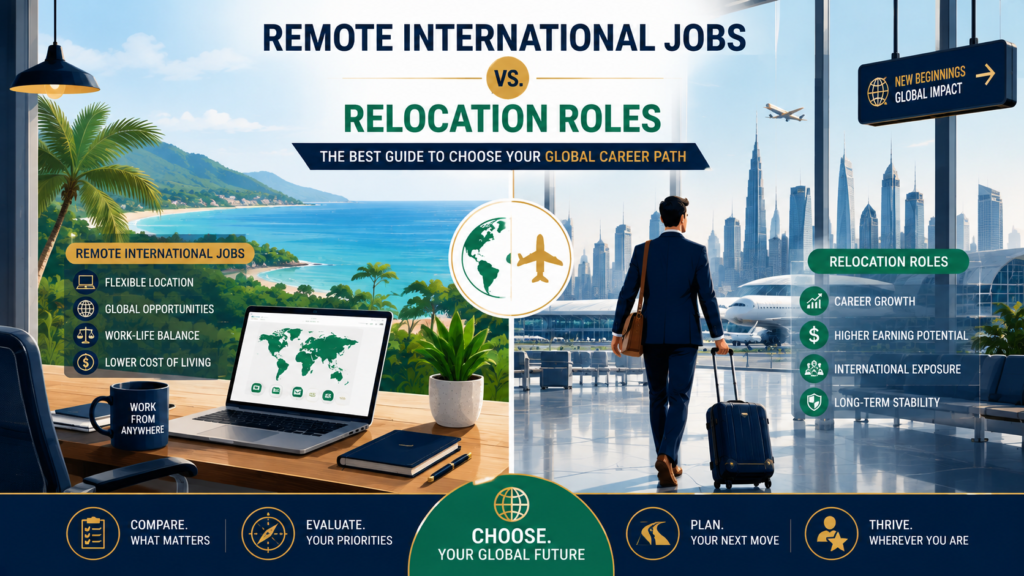
The global job hunt looks nothing like it did a decade ago. Today, ambitious professionals aren’t just choosing between companies they’re choosing between entirely different ways of working across borders. On one side sits the world of remote international jobs, where you work from anywhere while employed by an overseas company. This category covers everything from overseas remote jobs at established multinationals to fully distributed remote jobs worldwide, including international work from home jobs and overseas work from home jobs that let you earn a foreign salary without ever leaving home. On the other side sits the traditional corporate relocation package, where you physically move abroad with company backing. Both paths offer genuine opportunity, but they lead to very different lifestyles, financial outcomes, and career trajectories. This guide breaks down both options so you can build a smarter overseas job hunting strategy.
The Remote International Job Path (Work-From-Home Overseas):
For many professionals, remote international jobs represent the ultimate flexibility play: full geographic freedom, without ever needing to pack a suitcase for good. In fact, international work from home opportunities have expanded rapidly as more companies embrace distributed hiring across borders.
Pros
- Geographic freedom: Work from wherever suits your lifestyle, whether that’s a home base or a rotating list of countries.
- No relocation stress: Skip the logistics of shipping belongings, house-hunting abroad, or uprooting a household.
- Geo-arbitrage potential: Earning a work from home global salary in a strong currency while living in a lower cost-of-living region can meaningfully stretch your income.
- Maintained community ties: Stay close to family, friends, and existing local networks instead of starting over socially.
Cons
- Time zone friction: Coordinating meetings and collaboration across significant time differences can quickly become exhausting.
- Tax and compliance complexity: Understanding Employer of Record vs work visa structures — and whether you’re classified as an EOR employee or an independent 1099 contractor — is essential, since getting it wrong can create real legal and tax exposure.
- Limited in-person networking: Career-defining relationships often still form face-to-face, and remote setups can make those harder to build.
- Isolation risk: Without an office or in-person team, some remote professionals report feeling disconnected from company culture over time.
The Full Relocation Package Path (On-Site / Hybrid Overseas):
By contrast, a corporate relocation package offers a fundamentally different value proposition: full immersion, backed by company resources.
Pros
- Corporate support: Employers typically cover visa sponsorship, flights, temporary housing, and often a settling-in stipend.
- Cultural immersion: Living abroad full-time offers a depth of experience that remote work simply can’t replicate.
- Faster career advancement: In-person exposure to leadership and cross-functional teams often accelerates promotion timelines compared to remote-only roles.
- Path to permanent residency: In many top-tier markets, sustained physical presence is a prerequisite for long-term visas, permanent residency, or eventual citizenship.
Cons
- Culture shock: Adjusting to a new country’s language, customs, and daily rhythms can be genuinely difficult, even with support.
- High upfront adjustment costs: Even with relocation assistance, unexpected personal expenses often arise during the transition.
- Family and dependent strain: Partners, children, and aging family members can face significant disruption, from schooling changes to spousal visa complications.
- Binding contracts: Many relocation packages include clawback clauses, requiring repayment of relocation costs if you leave the role within a set period.
Side-by-Side Comparison Matrix:
| Factor | Remote International Jobs | Corporate Relocation Package |
|---|---|---|
| Upfront Costs | Low — no moving or visa costs | High, though often subsidized by employer |
| Visa & Tax Logistics | Complex (EOR vs. contractor status) | Employer-managed, but tied to sponsorship |
| Long-Term Career Growth | Steady, but slower leadership exposure | Often faster, via in-person visibility |
| Lifestyle Impact | Minimal disruption to daily life | Significant, full cultural immersion |
| Earning Potential | Strong if paired with geo-arbitrage | Strong, plus potential PR/citizenship value |
Decision Framework How to Choose What Suits Your Goals:
Ultimately, the right path depends less on which option is “better” and more on which fits your current life stage and priorities.
Choose Remote International Jobs if:
- You have strong family or personal commitments tying you to your current location
- Geo-arbitrage — earning more while spending less — is a top financial priority
- You value flexibility and autonomy over structured career acceleration
- You’re comfortable managing your own tax and compliance logistics, or working with an EOR
Choose a Relocation Package if:
- You’re seeking permanent residency or citizenship in a specific country
- You’re earlier in your career and want accelerated networking and mentorship
- You want full cultural immersion, not just a change of scenery
- You’re able to commit to a multi-year contract without major disruption to dependents
Conclusion :
Both paths offer legitimate, rewarding routes into a genuinely global career. What matters most is aligning your choice with a clear-eyed view of your 3–5 year goals: Are you optimizing for flexibility and lifestyle design through remote international jobs, or for accelerated growth and long-term settlement abroad? Once you’re honest about that answer, the right international career transition strategy becomes far easier to see — and far easier to execute with confidence.